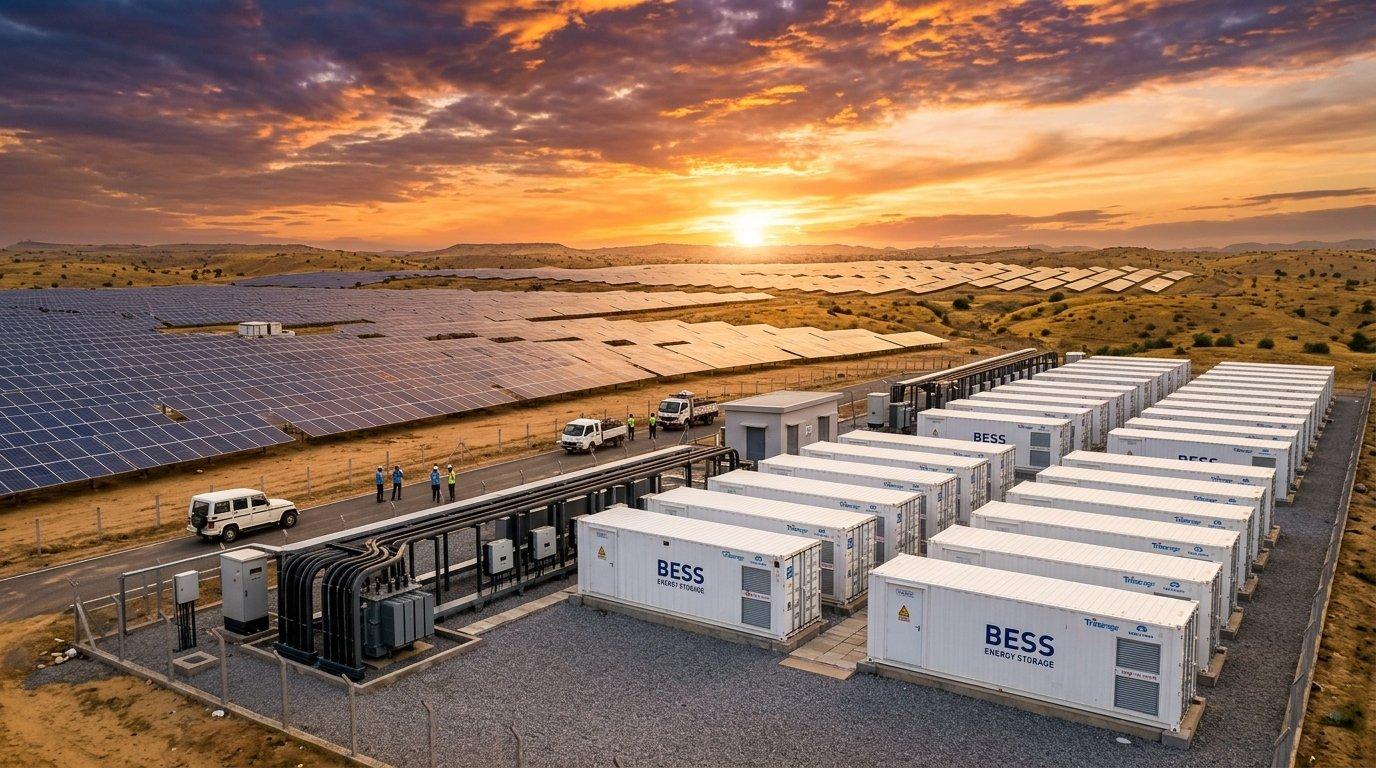
The issuance and progressive allocation of the landmark 3,200 MWh (3.2 GWh / 1,200 MW) standalone Battery Energy Storage System (BESS) tender by the Solar Energy Corporation of India (SECI) marks a historic turning point in the subcontinent's clean energy transition. Representing the single largest procurement of battery storage in South Asia, this tender formally operationalizes the Ministry of Power's ₹9,400 Crore Viability Gap Funding (VGF) budgetary framework, which offers sovereign capital grants covering up to 40% of total project CAPEX.
The tender is structured under a competitive Build-Own-Operate (BOO) model spanning a 12-year operational lifespan. Winning Independent Power Producers (IPPs) enter into tripartite Energy Storage Facility Agreements (ESFA) with SECI and beneficiary State Distribution Companies (DISCOMs). Offtakers receive guaranteed on-demand dispatch rights for two complete charging and discharging cycles per day, while the storage developer receives an inflation-hedged, fixed monthly capacity charge (denominated in ₹ / MW / month), completely insulating the asset owner from volume off-take risk.
Enables utility-scale economies of scale for battery procurement
VGF Sovereign Grant
Up to 40% of Project CAPEX
Disbursed in 3 milestone tranches: 20% / 40% / 40%
Compresses equity requirement and bolsters project IRR to 15%+
Discovered Capacity Charge
₹3.80 – ₹4.49 Lakh / MW / month
Fixed annuity billing based on 98.0% system availability
Establishes new historical global cost benchmark for standalone BESS
Contractual Duration
12 Years from COD
Mandates planned battery augmentation at Year 6–8
Requires robust lifecycle degradation modeling in project debt sizing
The aggressive tariff discovery demonstrates that utility storage in India has crossed the inflection point: energy storage is no longer an experimental pilot program, but an indispensable, bankable pillar of national transmission planning.
2. Sector Market Dynamics & Power Demand Drivers
India's power grid is undergoing the most rapid renewable buildout in world history, targeting 500 GW of non-fossil capacity by 2030. However, the physical reality of the grid has created acute structural challenges. Solar generation in resource-rich states like Rajasthan and Gujarat routinely generates massive midday surpluses between 11:00 AM and 2:00 PM, driving spot market power prices on the Indian Energy Exchange (IEX) down toward ₹1.50/kWh or even zero.
Conversely, when the sun sets, India's national peak power demand surges above 250 GW, driven by residential cooling, commercial lighting, and industrial shifts. During these evening peak hours (7:00 PM to 10:30 PM), the national grid faces severe power deficits, sending IEX Day-Ahead Market (DAM) prices hitting the statutory ceiling of ₹10.00/kWh. This extreme price differential—exceeding ₹8.00/kWh between midday solar surplus and evening peak deficit—creates an unprecedented economic arbitrage window for utility-scale battery storage.
Furthermore, statutory policy mandates are enforcing storage integration. Under the Ministry of Power's revised Energy Storage Obligation (ESO) trajectory, designated power utilities must procure an increasing percentage of their total electricity from energy storage systems, scaling from 1.0% in FY 2023-24 to 4.0% by FY 2029-30. DISCOMs failing to meet these targets face punitive regulatory non-compliance penalties, ensuring an expanding, non-discretionary pipeline of utility storage procurement.
3. Solar-Plus-Storage Technical Architecture for Mission-Critical Facilities
Delivering on SECI's contractual mandates requires an optimized engineering architecture centered on high energy density, thermal safety, and ultra-high efficiency. Bidders in the 3.2 GWh tender have universally transitioned away from legacy 280Ah cells in favor of advanced 314Ah Lithium Iron Phosphate (LFP) prismatic cell technology.
Standardized containerization architectures now house 5.0 MWh of storage capacity within a standard 20-foot ISO container footprint. This achieves a 34% increase in energy density compared to legacy 3.72 MWh enclosures, drastically reducing the required land footprint, civil foundation costs, and internal 33kV cabling. The technical architecture relies on three integrated subsystems:
1500V DC High-Voltage Bus Topology: High-voltage DC strings minimize I²R transmission losses, enabling large-block central Power Conversion Systems (PCS) rated at 2.5 MW to 3.45 MW with efficiency curves exceeding 98.8%.
Direct-to-Plate Liquid Cooling Circuits: Indian deployment sites in Rajasthan and Andhra Pradesh experience ambient temperatures exceeding 48°C. Direct cold-plate liquid cooling circuits maintain cell temperatures within the optimal 25°C ± 2°C window, limiting auxiliary parasitic power consumption to under 8.5% of total system throughput (compared to 18%+ for legacy air-cooled systems).
Grid-Forming (GFM) Control Topologies: Utilizing virtual synchronous machine (VSM) algorithms, the PCS provides synthetic inertia, sub-second frequency droop response, and black-start capability, satisfying the Central Electricity Authority (CEA) 2024 Connectivity Regulations.
Translating aggressive tender bids into operational reality requires navigating formidable execution, supply chain, and statutory bottlenecks across the Indian power sector:
Chief Electrical Inspector to Government (CEIG) Statutory Clearance: Securing state-level CEIG charging permissions represents the single greatest critical-path risk for storage projects. Megawatt BESS installations require specialized documentation—including battery compartment fire safety NOCs, transformer neutral grounding studies (< 1.0 Ω earth resistance), and dual-barrier isolation drawings—that unfamiliar local contractors struggle to clear within scheduled COD windows.
Inter-State Transmission System (ISTS) Substation Connectivity: Interconnecting multi-hundred-megawatt storage assets at Central Transmission Utility (CTU / PowerGrid) 220kV or 400kV substations requires Stage-I and Stage-II connectivity clearances, dedicated bays, and extensive dynamic grid modeling in PSCAD to prove zero harmonic resonance.
Battery Augmentation Strategy & Lifecycle Reserves: Under a 12-to-15-year PPA requiring 2 daily cycles, LFP cells experience calendar and cycling degradation that reduces usable capacity to ~70% by Year 6. EPC engineering models must pre-design container space, DC bus margins, and inverter oversizing to execute mid-life augmentation without causing extended plant outages.
Cell Import Tariffs & Supply Chain Logistics: With domestic Indian gigafactory manufacturing still scaling, cell procurement remains dependent on imports. EPC contractors must navigate Basic Customs Duty (BCD) compliance, Authorized Economic Operator (AEO) port customs clearance, and heavy-haul road transportation across national highways for 40-tonne container skids.
5. Strategic Implications for Indian IPPs, C&I Offtakers & Global Developers
The SECI 3.2 GWh tender establishes a permanent benchmark for how future renewable energy and storage capacity will be tendered, financed, and contracted in India. The commercial ramifications extend across the entire energy value chain:
Mainstreaming of Standalone Storage Asset Class
Storage is no longer merely an appendage to solar farms; it is an independent, debt-fundable asset class. Domestic financial institutions (PFC, REC, IREDA) and international climate funds now offer non-recourse project finance for BESS with 75:25 debt-to-equity ratios and 15-year tenors.
Catalyst for State-Level Storage Tenders
Following SECI's success, individual state utilities (including GUVNL in Gujarat, MSEDCL in Maharashtra, and TANGEDCO in Tamil Nadu) are rolling out their own gigawatt-scale standalone storage tenders, dramatically expanding the addressable EPC pipeline.
Industrial C&I Energy Storage Acceleration
Discovered utility price points are establishing bankability benchmarks for private industrial consumers. Heavy industries, chemical plants, and data centres are modeling behind-the-meter storage to capture peak tariff shaving and avoid demand charges.
The Premium on Turnkey EPC Execution
With thin margins in highly competitive auctions, developers cannot afford project delays or RTE shortfalls. Partnering with a turnkey EPC contractor providing integrated balance-of-plant, CEIG statutory management, and performance wraps is the ultimate differentiator.
The successful delivery of the 3.2 GWh tender will solidify India's position as one of the top three global markets for energy storage, alongside China and the United States.
What is the scope and structure of India's 3.2 GWh standalone BESS tender issued by SECI?
The SECI 3.2 GWh (1,200 MW) tender represents one of the world's largest sovereign standalone energy storage procurements. Developed under a Build-Own-Operate (BOO) model, it leverages the Ministry of Power's Viability Gap Funding (VGF) scheme, which covers up to 40% of capital expenditure. Selected IPPs enter into 12-to-15-year Energy Storage Facility Agreements (ESFA) with central and state offtakers, receiving monthly fixed capacity charges (₹/MW/month) in exchange for guaranteeing system availability (≥98%) and two full charge-discharge cycles per day.
What were the discovered capacity charges and tariffs in recent Indian utility BESS tenders?
Recent reverse auctions in India have demonstrated dramatic storage cost reductions, with discovered capacity charges dropping from ₹10.84 Lakh/MW/month in early 2022 pilots to approximately ₹3.80 to ₹4.49 Lakh/MW/month in recent SECI and state DISCOM tenders (such as Gujarat's GUVNL). On a levelized throughput basis, this translates to an effective storage cost of ₹4.20 to ₹4.80 per kWh, making BESS competitive against peaking open-cycle gas turbines and thermal peakers.
What are the minimum contractual availability and round-trip efficiency (RTE) thresholds enforced in SECI BESS contracts?
SECI tenders enforce strict operational performance parameters: annual availability must remain at or above 98.0%, with punitive liquidated damages levied for every percentage point drop. Furthermore, the system must achieve an AC-to-AC round-trip efficiency (RTE) of at least 85.0% measured at the 33kV or 220kV delivery point. RTE shortfall triggers severe tariff deductions, incentivizing EPCs to deploy low-loss liquid cooling architectures and ultra-efficient grid-forming inverters.
How does Viability Gap Funding (VGF) disbursement operate across construction and operational milestones?
The 40% sovereign VGF grant is disbursed in three structured tranches tied to verifiable construction milestones: Tranche 1 (20% of VGF) upon achievement of financial closure and commitment of 100% project debt/equity; Tranche 2 (40% of VGF) upon verified on-site physical delivery of 100% battery containers, inverters, and main step-up transformers; and Tranche 3 (40% of VGF) upon successful commercial operation date (COD), statutory CEIG energization clearance, and three consecutive months of verified 85%+ RTE performance.
Engineering Practice Directorate
Ultrathon Energy Advisory Desk
Ultrathon Electric's multidisciplinary engineering division prepares technical analyses, grid-code evaluations, and safety briefs to assist utilities, independent power producers (IPPs), and investors in navigating utility-scale energy storage and renewable deployments.
Engineering Advisory & Turnkey Delivery
Deploying Utility-Scale or C&I BESS in India?
Whether you are an IPP bidding for SECI / State DISCOM storage tenders or a large-scale commercial consumer requiring peak shaving and power backup, Ultrathon Electric provides end-to-end BESS EPC execution and Owner's Engineer advisory.
Control how your data is processed pursuant to India's DPDP Act 2023, EU GDPR, and CCPA/CPRA.
Strictly Necessary & Security
Always Active
Essential for site operation, CSRF protection, secure form routing, and infrastructure integrity. These cannot be disabled under Section 7 of India DPDP Act and GDPR Article 6(1)(b)/(f).
Analytics & Performance Telemetry
Optional
Collects aggregated, privacy-conscious visitor interactions and page telemetry via Google Analytics 4 (with IP masking). Helps us gauge technical demand and improve our power engineering content. Requires affirmative consent.
Functional & User Experience
Optional
Enables enhanced functionality such as preserving consultation form drafts, engineering unit preferences, and custom display layouts across repeat visits.
Statutory Rights & Third-Party Sale Exclusions:
India DPDP Act 2023: You have the right to withdraw consent at any time, request summary of personal data, and nominate a representative.
California CCPA/CPRA: We do not sell or share personal information for cross-context behavioral advertising.
EU/UK GDPR: You possess the right of access, rectification, erasure, restriction, and portability under Articles 15–22.
Read our full Privacy Policy or contact our Data Protection Officer at privacy@ultrathonelectric.com.